

The Defense Tech Supercycle
Why Global Security is Being Reprogrammed

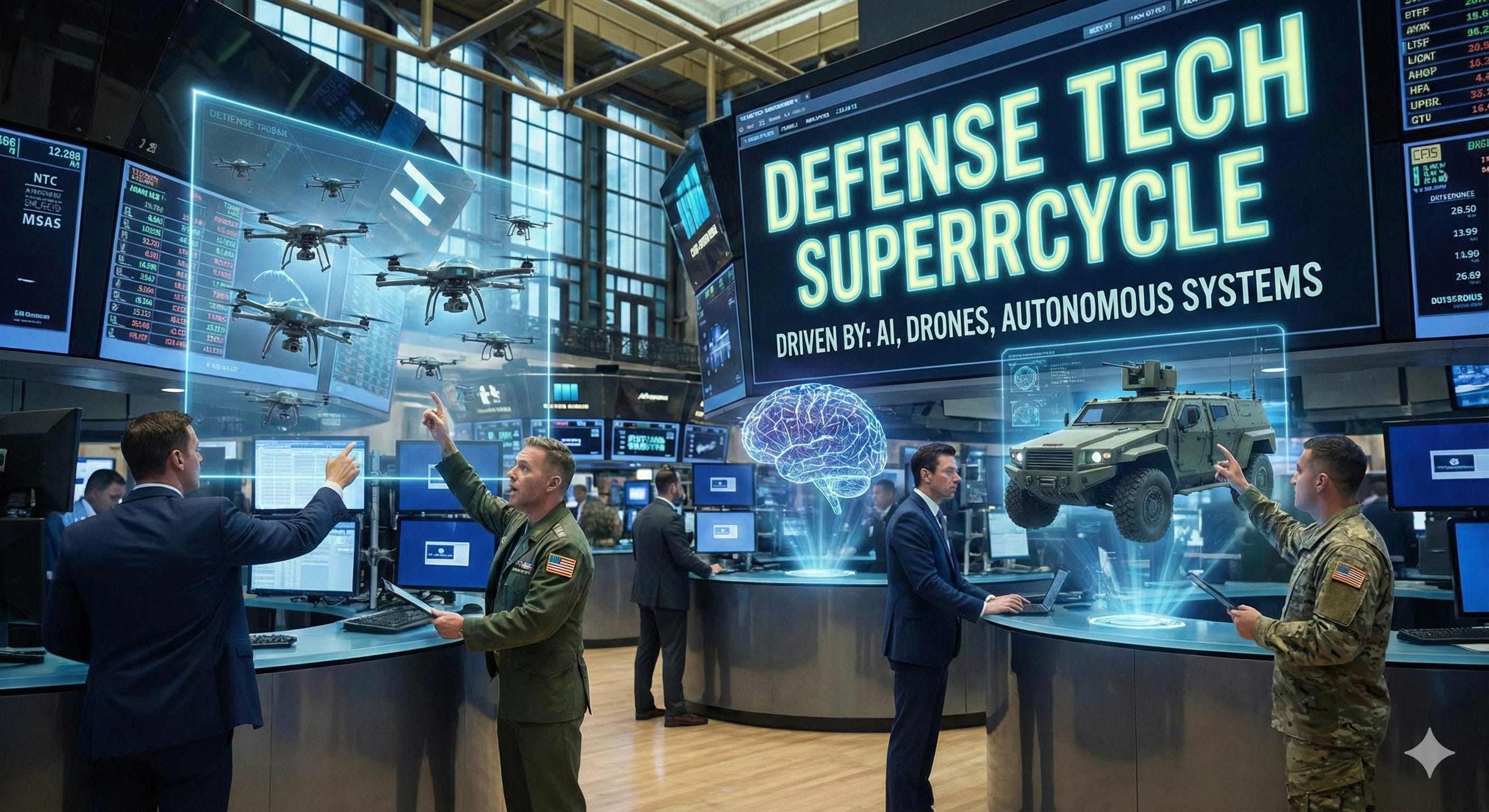
The year 2026 has emerged as a definitive turning point in the global security landscape. We are no longer witnessing a standard, cyclical uptick in defense spending driven by temporary geopolitical friction. Instead, we have entered a Defense Tech Supercycle—a profound, structural transformation of the military-industrial complex characterized by a shift from traditional “hardware-centric” defense to a software-defined, AI-driven paradigm. For investors and industry observers, this represents a total industrial and technological overhaul on a scale not seen since the Cold War.
1. The Economic Force Multiplier: Trillions as the New Baseline
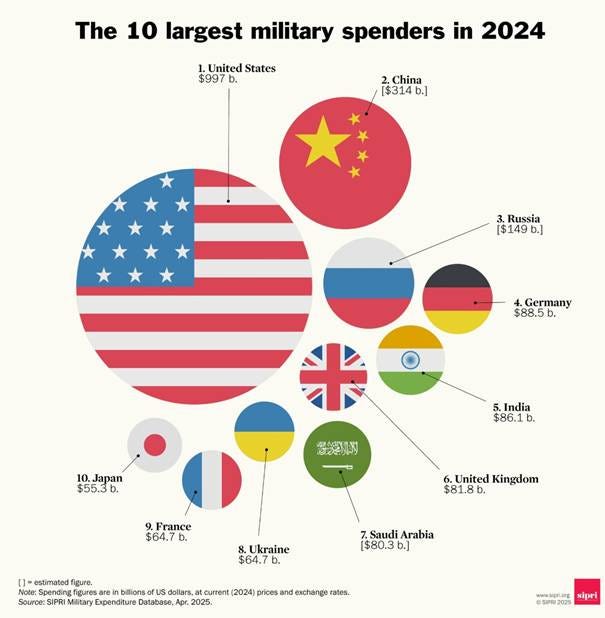
The sheer scale of capital being deployed into the defense sector is unprecedented. Global defense expenditures have surged to a staggering $2.7 trillion. However, the most significant catalyst for this supercycle is the “Trump Factor” in the United States.
The $1.5 Trillion Signal: The U.S. administration’s proposal to raise the defense budget to $1.5 trillion for 2027 serves as the ultimate market signal, forcing a global recalibration of defense fiscal policy.
The European Pivot: Europe has finally abandoned the “Peace Dividend” era. The previous 2% GDP spending target is being replaced by a new reality of 3.5% to 5% of GDP. Within this framework, Germany and Poland are emerging as the new military heavyweights of the continent, spearheading procurement and modernization efforts.
2. Technological Disruption: “Software Eats the Battlefield”
In this supercycle, the strategic value is shifting from “atoms to bits.” We are moving away from a reliance on massive, legacy platforms—such as traditional tanks and ships—toward software-defined systems.
Sensor Fusion & The OODA Loop: Modern warfare is increasingly a data management challenge. The integration of Sensor Fusion and Edge AI allows for decision-making in milliseconds, radically accelerating the OODA (Observe, Orient, Decide, Act) loop.
Hardened Edge AI: There is a critical investment focus on hardened Edge AI systems that can operate in contested environments without relying on vulnerable central clouds.
The “Replicator” Principle: To counter the numerical superiority of adversaries like China, the West is pivoting toward mass autonomy. The “Replicator” initiative focuses on deploying thousands of low-cost, high-tech autonomous drone swarms to overwhelm traditional, expensive high-end systems.
3. The New Industrial Architecture: Neo-Primes vs. Legacy Giants
The traditional “Primes” (Legacy defense contractors) are facing a disruptive challenge from a new generation of “Neo-Primes” that bring Silicon Valley’s agility and software-first DNA to the Department of Defense.
The Rise of the Challengers: Companies such as Anduril, Palantir, One Stop Systems OSS 0.00%↑ , and Ondas Holdings ONDS 0.00%↑ are redefining what it means to be a defense contractor by prioritizing rapid iteration and AI-centric hardware.
The End of Financial Engineering: A major structural shift is the move away from “financial engineering.” The U.S. administration’s crackdown on stock buybacks is forcing established defense giants to redirect their record profits into R&D, Gigafactories, and domestic industrial production.
Defense as a Core Asset Class: Defense technology has shed its niche status. Driven by massive Venture Capital (VC) inflows, the sector is being re-evaluated by ESG-conscious investors who now view national security as a prerequisite for societal stability.
4. Strategic Doctrine: The “Kill Web” and CJADC2
The tactical evolution of this supercycle is centered on total connectivity. The “Kill Web” replaces the traditional “Kill Chain,” creating a decentralized network where every asset—from a soldier’s headset to a satellite—is a node.
CJADC2: The implementation of Combined Joint All-Domain Command and Control (CJADC2) represents the goal of a fully networked battlefield.
Decentralized Resilience: Because traditional cloud infrastructures and physical data centers are highly vulnerable to kinetic and cyber attacks, the superior strategy has become the deployment of decentralized, mobile, high-performance AI systems in every vehicle and unit. This ensures operational capability even in environments with heavy jamming or severed communications.
5. Ethical Guardrails
Despite the growth, the supercycle faces significant ethical dilemmas: The prospect of AI systems making life-and-death decisions remains a central ethical concern for the industry and regulators.
6. Conclusion: An Era of Permanent Innovation
The Defense Tech Supercycle is not a fleeting trend; it is a decade-long secular growth story. For investors, the current global instability underscores the necessity of being positioned in a sector that has become the engine for the next stage of industrial development, comparable to the Space Race of the 1960s. We are moving toward an era of permanent innovation where the boundary between “tech” and “defense” effectively disappears.
This is not financial advice; the author holds a long position in $OSS and encourages independent due diligence.